





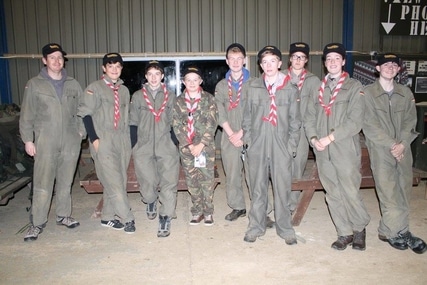
Back in April, we wrote a blog about the component parts of an Anderson Shelter, which we were looking to construct as part of the living museum area at Armourgeddon, engaging a local group of young people to help us with the construction project. The Explorer Scouts group from Market Harborough, The Mad Hatters, came up last week to help us construct the shelter, which is now pride of place in our museum.
The Explorers worked together as a team along with a couple of the instructors at Armourgeddon, to create the shelter; filling sand bags, managing the construction, adding the decoration and completing the shelter. The Explorers were great fun to have on site, enjoyed post-build refreshments in the Sherman Tank and left us with a fabulous new exhibition piece for the museum.
Great big thanks to The Mad Hatters, we hope to see you again soon for more projects!
The Anderson Shelter was designed in 1939 by William Paterson and Oscar Carl (Karl) Kerrison, at the request of the Home Office. Named after Sir John Anderson, the then Lord Privy Seal, Anderson was responsible for preparing air-raid precautions prior to the outbreak of WWII. Anderson Shelters were designed to accommodate up to six people and were constructed with six curved galvanized corrugated steel panels bolted together at the top forming the main body of the shelter. Three straight sheets were bolted to both sides and a further 2 panels fixed to both ends- one containing a door. The shelters were 1.8m (6 feet) high, 1.4m (4.5 feet) wide and 2m (6.5 feet) long. Buried 1.2m (4 feet) deep in soil and then covered with a minimum of 38cm (15 inches) of soil above the roof. Earth banks were then planted with flowers and vegetables and were often the focus of neighbourhood competitions.

The shelters were issued free to any household earning less than £5 per week- that would equate to £280 a week in 2016 when adjusted for inflation. Those earning a higher income were charged £7 (£390 in today’s money) for their shelter. There were 1,500,000 of these shelters distributed between February 1939 and the outbreak of the war. During the war years, a further 1.1 million were erected, many being produced at John Summers & Sons ironworks at Shotton on Deeside where production peaked at 50,000 shelters per week.
Anderson shelters were very effective at saving lives and preventing major injuries during air raids, but they were freezing at nighttime. When the weather got colder, the Government issued guidelines around how to make the Anderson Shelter more comfortable, but it was thought that people still headed back to their houses in the dead of night. The Morrison Shelter was developed to be constructed inside homes in order to combat these issues.
The ‘Blitz’ was a term used to describe the heavy bombing of London and other British cities during WWII starting on the 7th September 1940 and continuing through to the end of May 1941- the time for which Anderson Shelters were sent to households for protection. The term ‘Blitz’ came fro the Herman word blitzkrieg meaning ‘lightning war’.
In preparation for the air attacks, gas masks were given to all adults and children as it was expected that the bombs might contain poisonous gas and the gas mask protected the wearer from any potential fumes. In addition, bags were filled with sand and piled up to protect buildings, a number of civilians were made wardens to keep people in the right places at the right times.
The first air raid was carried out on the 7th September 1940 when over 350 German bombers flooded the skies over London, protected by a huge 650-strong fleet of fighter planes. Sirens sounded to alert London’s inhabitants, but London’s docks were destroyed and many buildings were hit causing catastrophic fires. On this date, which came to be known as Black Saturday, 448 people were killed and many thousands were injured.
Anti-aircraft guns were deployed to defend London and huge searchlights to see the planes in the darkness illuminated the skies. Barrage balloons were floated above UK cities forcing bombers to drop from a higher altitude making their chance of hitting target much less accurate.
Soon the London Underground was being used as a giant air raid shelter and although initially the Government attempted to halt this process, people continued to force their way in. Living in the Underground became a way of life during The Blitz. With over 60,000 people sleeping in the underground tunnels, they soon became cramped and rather pungent. Although usually a haven, on at least one occasion an Underground station received a direct hit and killed most of the Londoners hiding inside.
As well as London, other UK cities were not forgotten by the German air raids; Coventry was hit on the 14th November 1940 destroying the Cathedral, 21 factories and taking 568 lives. Newcastle, Swansea, Birmingham, Manchester, Nottingham, Ipswich, Portsmouth, Hull, Sheffield, Bristol and also Southampton- where fires were still burning 2 days later, where also hit.