
It’s not just all about the tanks!We have all sorts of military paraphernalia here at Armourgeddon so for this week’s blog we thought we would tell you all about the big guns we have on site.



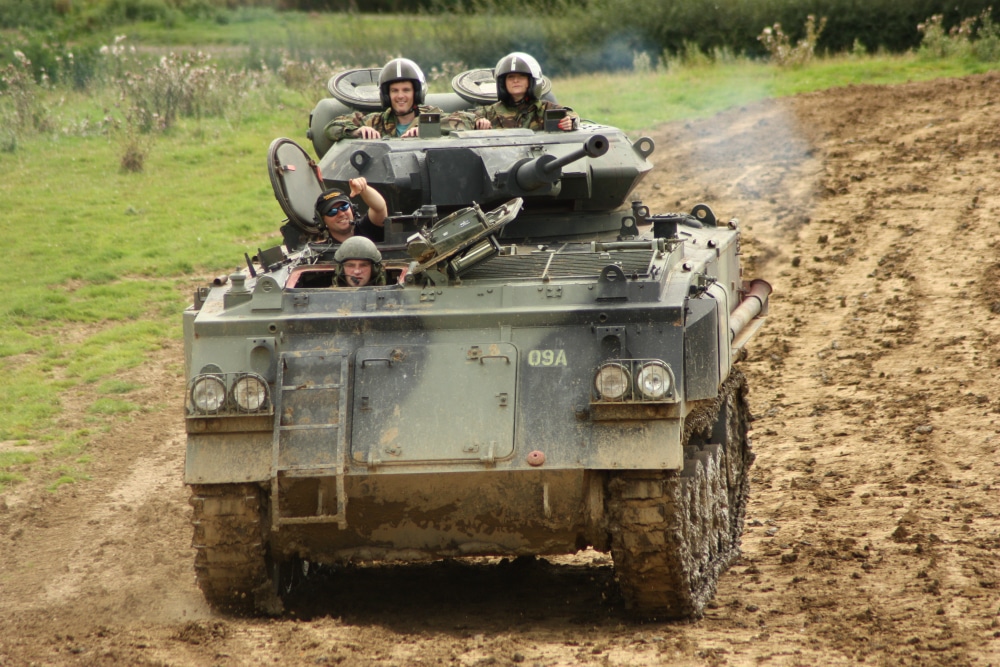


It’s not just all about the tanks!
Looking at the vast array of guns and riffles we have on display here at Armourgeddon, we thought we would share a couple of our favourites with you this week.
First up we have the QF3.7inch AA. This Quick Fire Anti Aircraft gun was Britain’s primary heavy anti-aircraft gun during World War II. Roughly the equivalent to the 88mm FlaK utilized by the German army as well as the American 90mm. However the QF 3.7inch AA has a larger calibre at 94mm.
The QF3.7inch AA saw active service throughout WWII in all battle areas except for those on the Eastern Front. There were 6 different versions of the gun with two in particular produced in considerable numbers- mobile and fixed.
Having first seen active duty in WW1, the war showed the heightened possibility of air attacks from enemy forces. In 1928 the general characteristics for the new anti-aircraft guns were agreed upon; a bore of 3.7 inches (94mm) firing 25lb (11kg) shells with a ceiling of 28,000 ft (8.5 km). However, with military finances stretched to a maximum post WWI, nothing was done with the blueprints until the 1930s. At that time the specification was enhanced to a 28lb (13kg) shell with a 3,000 ft per second (910 m/s) muzzle velocity and a 35,000ft (11km) celing. The towed road speed was 25 mph and a maximum weight if 8 tons. The gun could be battle ready within 15 minutes with a highly trained crew.
In 1934, the production facility at Vickers Armstrong produced a mock-up and preceeded to develop prototypes which were pass through testing in 1936. On 1st January 1938 the British air defences had 180 anti-aircraft guns larger than 50mm. By September that number had increased to 341 when the Munich Crisis occurred and by 540 at the declaration of the outbreak of WWII in September 1939 and up to 1140 during the Battle of Britain. Production continued until 1945 averaging 228 guns through production per month during that time.
Inside the museum at Armourgeddon, we have a number of wheel based and hand held guns on display. The Maxson M55 Quad Gun Trailer is made up of an M45 Quadmount atop an M20 Gun Trailer. It was designed to provide heavy anti-aircraft firepower and yet be light enough to be towed behind a Willy’s Jeep by the American Army.
The M45 Quadmount consisted of four .50 calibre M2 Browning machine guns, mounted in pairs on each side of an electrically powered turret. Developed by the W.L Maxson Corporation in New York, the M55 the earlier twin mounted M33.
Again with the main aim of anti-aircraft protection, introduced in 1943, it’s effectiveness against targets earned the M55 the nickname of ‘Meat Chopper’ and ‘Krautmower’ because of it’s capability to fire between 450 and 575 rounds per minute, per gun. With all 4 guns fully operational, that meant 2,300 rounds per minute.
The Meat Chopper remained in active service for the US Army as late as the Vietnam War and is still in service in some countries today.
In addition, the museum also houses a Pak 38 and a Pak 40. The German forces initially used the Pak 38 during WWII in April 1941. When faced with the Soviet tanks in 1941 during Operation Barbarossa, the Pak 38 was one of the few early guns capable of penetrating the 45mm (1.8inch) armour which defended the T-34. The Pak 38 was also used in the Atlantic Wall because of its range and anti-tank capabilities; a very useful piece of equipment to battle against allied forces on the shore.
Although the Pak 38 was replaced by more powerful weapons, it remained deployed and a useful weapon for active duty by the Wehrmacht until the close of WWII.
The 7.5cm Pak 40 (7,5cm Panzerabwehrkanone 40) was a German 75mm anti-tank gun developed in 1939-1941 by Rheinmetall and formed the backbone of German anti-tank guns for the latter part of WWII.
Having been contracted to production at both Krupp and Rheinmetall in 1939, priority for the production of the Pak 40 was initially low, it was increased after the 1941 invasion of the USSR and the unexpected attack from the heavily armoured T-34 and KV-1 Russian tanks. In April 1942 the Wehrmacht had 44 guns in service. Within 12 months, the Pak 40 formed the mainstay of the German anti-tank artillery.
After the end of the war, the Pak 40 remained in service in several European armies including Albania, Bulgaria, Chechoslovakia, Finland, Norway, Hungary and Romania. In total about 20,000 Pak 40s were produced and about 3,500 more were used to arm tank destroyers.
Here at the Armourgeddon Museum, not only are these guns on display, we also have numerous riffles that can be held and other larger guns within the displays.
Entrance to the museum is just £5 and free for under 5s. Open from 9am-5pm every day except bank holidays. We have something to interest everyone- you will be transfixed within minutes!
Share this story:
Get intel on new tanks, exclusive offers, and special ops you won’t want to miss!
Please help us with a few of your requirements and we’ll get right back to you.
Please help us with a few of your requirements and we’ll get right back to you.
Build your private party or group booking and we’ll be in touch with an incredible itinerary.