
There are three factors that determine a tank’s capability and effectiveness. These are its firepower, protection and mobility. Firepower is the ability for a crew to identify, engage and ultimately destroy the enemy. Protection refers to the ability to remain undetected to preserve the tank from enemy fire thus remaining fully functional after combat. Finally, mobility refers to the transportability of the tank- by rail, sea and air to the staging area; from the staging area by road toward the enemy; and tactical movement over the battlefield during combat including overcoming obstacles.





There are three factors that determine a tank’s capability and effectiveness. These are its firepower, protection and mobility. Firepower is the ability for a crew to identify, engage and ultimately destroy the enemy. Protection refers to the ability to remain undetected to preserve the tank from enemy fire thus remaining fully functional after combat. Finally, mobility refers to the transportability of the tank- by rail, sea and air to the staging area; from the staging area by road toward the enemy; and tactical movement over the battlefield during combat including overcoming obstacles.
Tank design requires a balancing act between technology, budget and tactical capability requirements. It is not possible to maximise firepower, protection and mobility simultaneously while incorporating the latest technology and retain affordability for sufficient procurement quantity to enter production. For examples, in the case of the Abrams MBT, which has good firepower, speed and armour, these advantages are counterbalanced by its engine’s notably high fuel consumption, which ultimately reduces its range, and in a larger sense its mobility.
Some tank designs that were fielded in significant numbers, such as Tiger I and M60A2 proved to be too complex or expensive to manufacture, and made unsustainable demands on the logistics services support of the armed forces. In practice, the gains of the T-34 and M4 Sherman with their simple designs and compromises of engineering over the more sophisticated, expensive and complex German designs which caused great stretch on the logistics of the Wehrmacht show the obvious positives of the Allied Forces’ school of thought. As most time spent by the crews of tanks is on the maintenance of their vehicle, the simplest engineering designs have become of paramount importance since WWII despite advances in mechanical, electrical and technical know-how.
Since the Second World War, a number of more unusual designs have appeared with mixed success- the Soviet IT-1 and T-64 show great advances in firepower, the Israeli Merkava and Swedish S-tank for protection and the M551 was the first, and for a long time, only tank light enough to be deployed by parachute.
In addition to design, of course, a name is a vital part of the tanks armoury. Many British tanks are now given names beginning with C. It was originally thought that these were just Cruisers, but current MBTs do also. IFVs are starting with S, however. There are a few folk law stories about names too- Valentine, a private venture is thus named as it was presented on Valentine’s Day… as for Matilda…. Who knows!
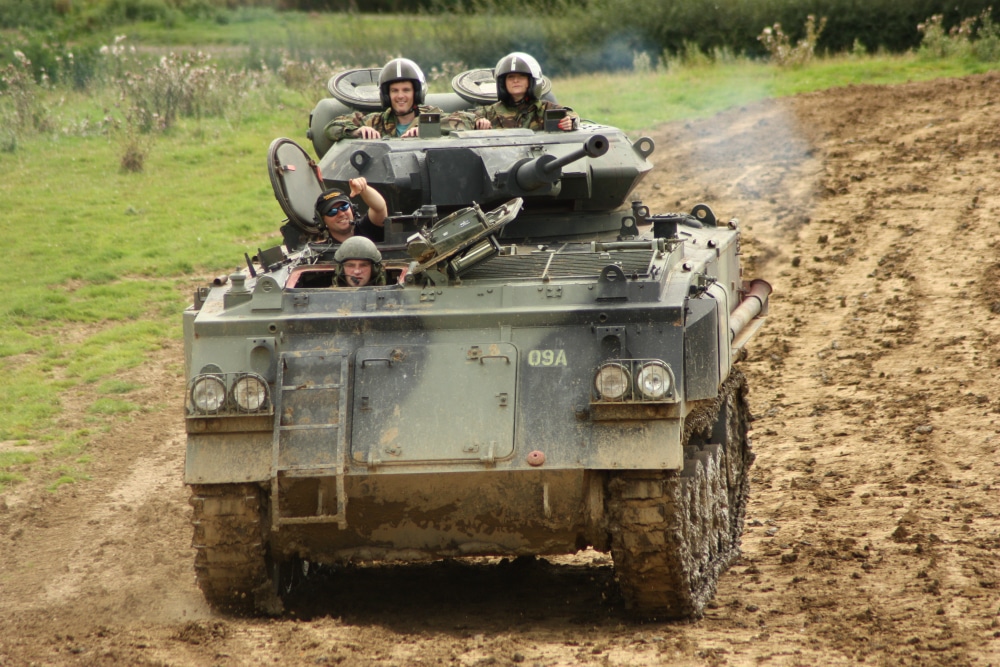
Here at Armourgeddon, we name our FV432s that we embark on Tank Paintball with for many different reasons. Their names are: Aimee, Jane, Rebecca Joyce, Sally, Vivian, Sandy, Katie, Jessica, Martha, Stella, Ellie-May, Jeanie, Meg, Rosie, Connie and Sam. After a Facebook competition this week, we will be naming our next FV432 Poppy in commemoration of 100 years since the outbreak of WWI 1914-2014.
Share this story:
Get intel on new tanks, exclusive offers, and special ops you won’t want to miss!
Please help us with a few of your requirements and we’ll get right back to you.
Please help us with a few of your requirements and we’ll get right back to you.
Build your private party or group booking and we’ll be in touch with an incredible itinerary.